

Campus Map and Locations
In this section, we cover the principal Campus locations and the ordinary purpose of each major area.
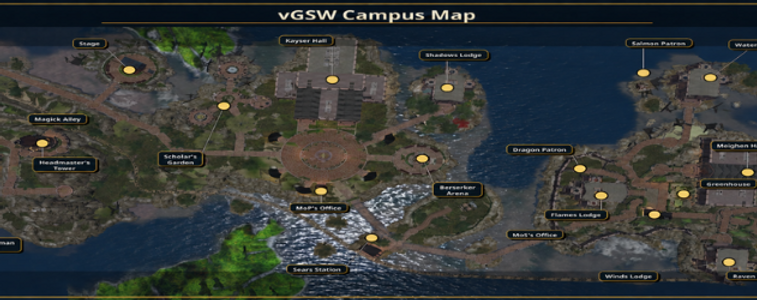
Campus Map and Locations
The Campus map identifies the principal areas used for live course sections, Lodge life, administrative work, public programs, study, events, pupil recognition, and approved recreation. Pupils are encouraged to become familiar with these locations early, as course section notices, event announcements, Lodge communications, and Faculty instructions may refer to them by name.
The descriptions below provide a general guide to the Campus layout and the ordinary purpose of each location. They are not meant to replace posted notices, event instructions, access requirements, or Faculty direction. A hall, office, Lodge space, or common area may have different uses depending on the academic calendar, scheduled course sections, Lodge activity, administrative need, or public programming.
Orientation and Campus Essentials
The Information Center serves as a principal point of arrival and orientation for visitors and prospective pupils. It is an appropriate starting place for those seeking general information, directions, and an introduction to the structure of Campus life. Because it may be one of the first places a newcomer encounters, pupils should conduct themselves there with the awareness that their behavior reflects upon the institution as a whole.
Magick Alley is a practical Campus district where pupils may obtain the items needed for ordinary Campus participation, including the School armguard, uniform, and Hub. These tools support recognition, communication, and access within many Campus systems, and pupils should become familiar with them early. Magick Alley may also provide approved uniform variations, attachments that display University or Lodge pride, and selected items suitable for personal Sanctum use. Its purpose is practical as much as social: it helps pupils prepare to participate properly in the life of the Campus.
The Campus is also served by three train stations: Tutoria Station, Sears Station, and Ozmeade Station. These stations connect the three regions of the Campus and provide recognizable points of movement between major areas. Pupils should use station areas with courtesy, particularly near the beginning or end of scheduled course sections, meetings, and events.
Academic, Pupil Life, and Administrative Locations
The Lecture Hall is one of the primary academic spaces on Campus, used for live course sections, lectures, presentations, and approved institutional gatherings. Pupils attending activities there should arrive prepared, follow the direction of the instructor or host, and participate in a manner suited to an academic setting.
Meighen Hall is the central academic building where classes, meetings, and major gatherings may take place. It houses the Great Hall, which serves as an important venue for University assemblies and formal Campus gatherings. Meighen Hall also contains books with sections of lesson material, allowing pupils to encounter portions of the curriculum within the Campus itself.
Faculty Hall is associated with Faculty presence, professional activity, meetings, and institutional functions connected to instruction. Pupils should enter or use this area according to posted expectations, invitation, appointment, or Faculty direction.
Kayser Hall is the major pupil life and leadership building on Campus. It includes two club rooms, a commons area, displays of particularly strong pupil work, the Captain’s Office, Leadership Chambers, and Graduation Hall. It also houses the Lodge and School trophies, making it an important location for recognition, achievement, institutional memory, and the visible life of pupil leadership.
The Headmaster’s Tower represents the office and institutional presence of the Headmaster on Campus. It is a formal location connected to the direction of the University, major announcements, administrative meetings, and the work of the Headmaster within the Campus environment.
The MoP’s Office is connected to pupil affairs, guidance, conduct, community life, and the pupil-facing work of the institution. The MoS’s Office is connected to academic direction, curriculum, instructional structure, and the course of study. These offices should be understood as formal locations for University business rather than casual gathering spaces.
Journeyman Hall is associated with advanced academic progress and records connected to the Journeyman stage of study. Because its purpose involves later-stage pupil work, its expectations and systems are addressed separately in the Handbook section on Journeyman Hall and advanced records.
Lodge Areas
The Campus includes dedicated Lodge spaces for the Flames Lodge, Waters Lodge, Winds Lodge, Stones Lodge, and Shadows Lodge. These locations give each Lodge a visible home within the Campus and provide places for Lodge identity, meetings, fellowship, announcements, and approved Lodge activity.
Lodge spaces are part of the University’s community structure and pupils should respect the character and purpose of their own Lodge area, and should show equal courtesy when visiting the area of another Lodge. Inter-Lodge competition and fellowship should remain honorable, mature, and consistent with the reputation of the Grey School.
Event, Study, and Community Spaces
The Stage is a public event location used for assemblies, presentations, performances, announcements, and other scheduled gatherings. Because activities held there may include visitors or represent the institution publicly, pupils should be especially mindful of conduct, timing, and attention to the host or presenter.
The Scholar’s Garden provides an outdoor setting for conversation, reflection, study, and quieter gatherings. It also offers over 100 pages of lesson material on plants, animals, great thinkers and the lodges themselves for the interested pupil to explore at their leasure.
The Ritual Space is a designated location for approved gatherings, demonstrations, observances, and other activities suited to its purpose. Pupils should not use it for unsanctioned activity or disruption, and should respect any event structure or instructions in place.
The Greenhouse is a specialized Campus location connected to study, demonstrations, projects, and approved programming. Its use may vary by course section, event, or project, and pupils should observe any instructions attached to its current activity.
The Berserker Arena is a designated area for approved recreation, competition, and structured activity. While its purpose is more active than many academic areas, it remains part of the Campus, and pupils using it are expected to follow posted rules.
Sanctums
The Sanctums are personal academic retreats within the Campus. They provide apprentices and magisters with dedicated spaces for study, writing, organization, creative work, and reflection, while also helping sustain the continued development of the Campus.
Because Sanctums carry their own expectations for rental, design, privacy, technical limits, approved furnishings, and resident responsibility, they are addressed in detail on campus. Pupils should review that information before renting, furnishing, or substantially altering a Sanctum.
Using the Map
The Campus map should be used alongside course section notices, event postings, Lodge communications, public announcements, and Faculty direction. When an activity names a location, pupils should arrive in good time, observe the purpose of the space, and conduct themselves in a manner appropriate to that setting.
The Campus is an academic and community environment with many kinds of spaces serving different institutional needs. Familiarity with the map helps pupils move through that environment confidently, attend scheduled activities on time, locate offices and halls, find Lodge areas, and participate more fully in the life of the Grey School.
